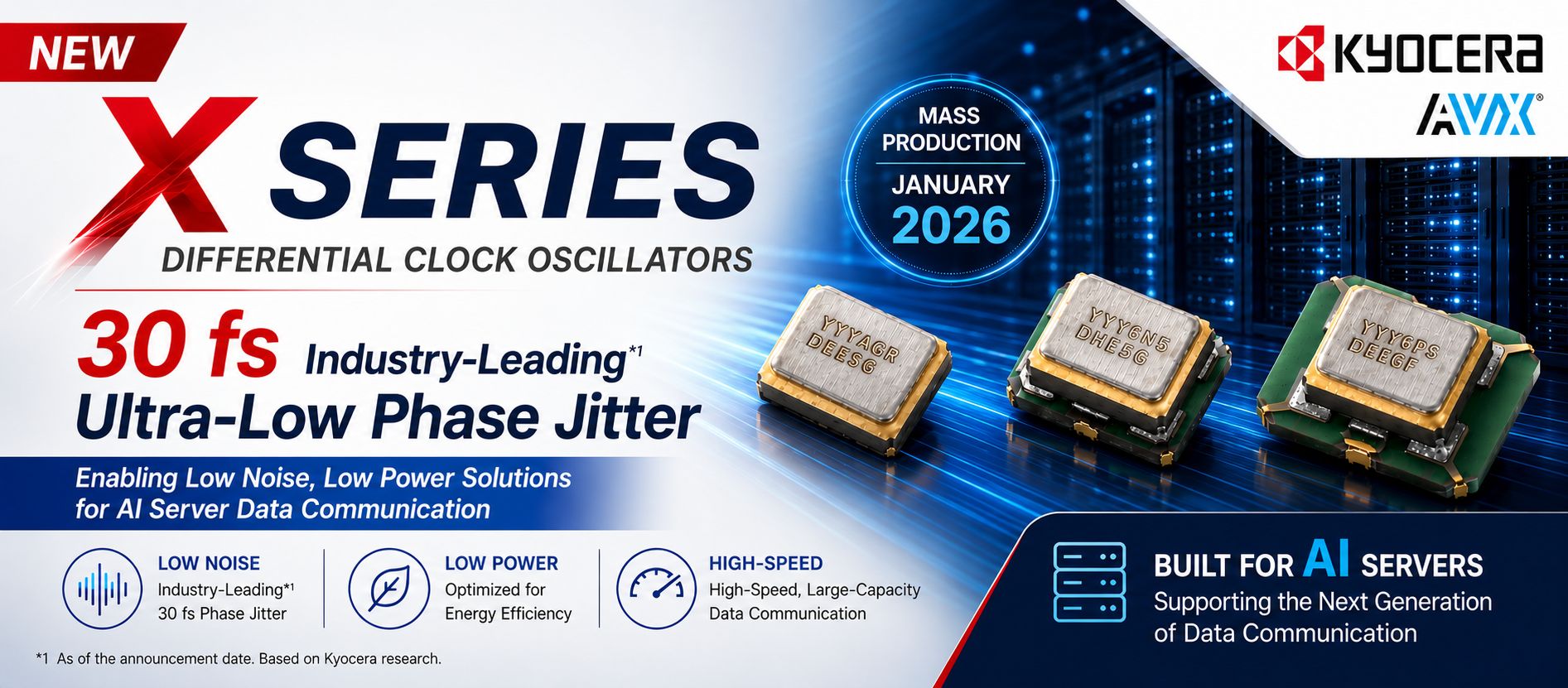




Kyocera Begins Mass Production of the X Series: 30fs Differential Clock Crystal Oscillators for AI Servers
AI infrastructure is only as fast as its weakest signal path, and increasingly, that bottleneck is timing. Kyocera Corporation has announced the launch and mass production of its new X Series differential clock crystal oscillators, claiming an industry-leading phase jitter of just 30 femtoseconds (fs) alongside a substantial cut in power consumption. For engineers designing AI servers, optical transceivers, and high-speed storage systems, this is the kind of component-level improvement that translates directly into fewer bit errors and lower thermal budgets at the board level.
Mass production of the X Series began in January 2026 at Kyocera's Higashine Plant in Yamagata, Japan, with an initial monthly output of 200,000 units. Kyocera plans to scale that to 2 million units per month by June 2026, a clear signal of how fast demand for precision timing components is growing alongside the generative AI buildout.
Why Differential Clock Crystal Oscillators Matter for AI Servers
Most consumer and general-purpose electronics — smartphones, IoT sensors, basic control boards — rely on single-ended clock crystal oscillators. They're simple, inexpensive, and adequate when signal runs are short and noise is manageable.
Differential clock crystal oscillators work differently. They generate two complementary signals, and the receiving circuit reads the difference between them rather than a single voltage level. This has two practical benefits for high-speed systems:
- Common-mode noise picked up along the signal path cancels out at the receiver, since it affects both signal lines equally.
- The oscillator maintains stable, accurate timing over longer trace lengths and in electrically noisy environments, such as densely packed AI server boards.
As 5G network buildouts continue and AI data centers scale up, the demand on network equipment and servers to move more data, faster and more reliably, has pushed low phase jitter from a nice-to-have into a hard requirement. Even small timing deviations — phase jitter — can cause bit errors in high-speed serial links running at multi-gigabit rates. That's the exact problem the X Series is designed to solve.
Key Features of the Kyocera X Series
- Industry-Leading 30fs Phase Jitter
Kyocera achieved the 30fs phase jitter figure (at 312.5 MHz) by combining high-quality crystal blanks with advanced IC design — specifically, proprietary semiconductor photolithography, a compact plasma CVM (Chemical Vapor Machining) fabrication process, and a new high-performance IC. Compared to conventional differential oscillators running at the same frequency, that's roughly a 25% reduction in phase jitter, which meaningfully lowers the probability of bit errors in high-speed communication links.
At 156.25 MHz, typical phase jitter is 40fs — still a strong figure for this frequency class.
- Approximately 42% Lower Power Consumption
The X Series integrates a new differential-output oscillator IC that significantly reduces current draw. At 156.25 MHz with LV-PECL output, the X Series consumes just 29 mA, compared to a typical 50 mA for conventional products — a 42% reduction. For AI servers running thousands of these oscillators across racks of compute nodes, that adds up to meaningful savings in both power and cooling overhead.
- Compact, Flexible Package Options
The X Series is available in three package sizes to suit different board densities and design constraints:
|
Package Size (max.) |
Use Case |
|
2.0 × 1.6 × 0.7 mm |
Space-constrained, high-density boards |
|
2.5 × 2.0 × 1.0 mm |
General-purpose high-speed applications |
|
3.2 × 2.5 × 1.0 mm |
Applications prioritising thermal/mechanical margin |
X Series: Full Technical Specifications
|
Parameter |
Specification |
|
Output Frequency Range |
100 MHz / 125 MHz / 156.25 MHz / 312.5 MHz |
|
Output Type |
LV-PECL / LVDS |
|
Supply Voltage |
1.8V / 2.5V / 3.3V (1.8V for LVDS output only) |
|
Operating Temperature |
–40°C to +85°C, or –40°C to +105°C |
|
Frequency Tolerance |
±15 ppm (–40 to +85°C) / ±20 ppm (–40 to +105°C) |
|
Current Consumption |
29 mA (LV-PECL, 156.25 MHz) / 14 mA (LVDS, 156.25 MHz) / 45 mA (LV-PECL, 312.5 MHz) / 23 mA (LVDS, 312.5 MHz) |
|
Phase Jitter (typical) |
40 fs @ 156.25 MHz / 30 fs @ 312.5 MHz |
Where the X Series Fits: Primary Applications
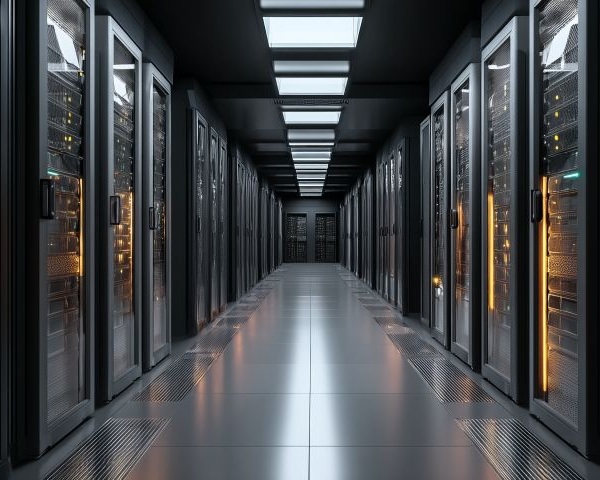
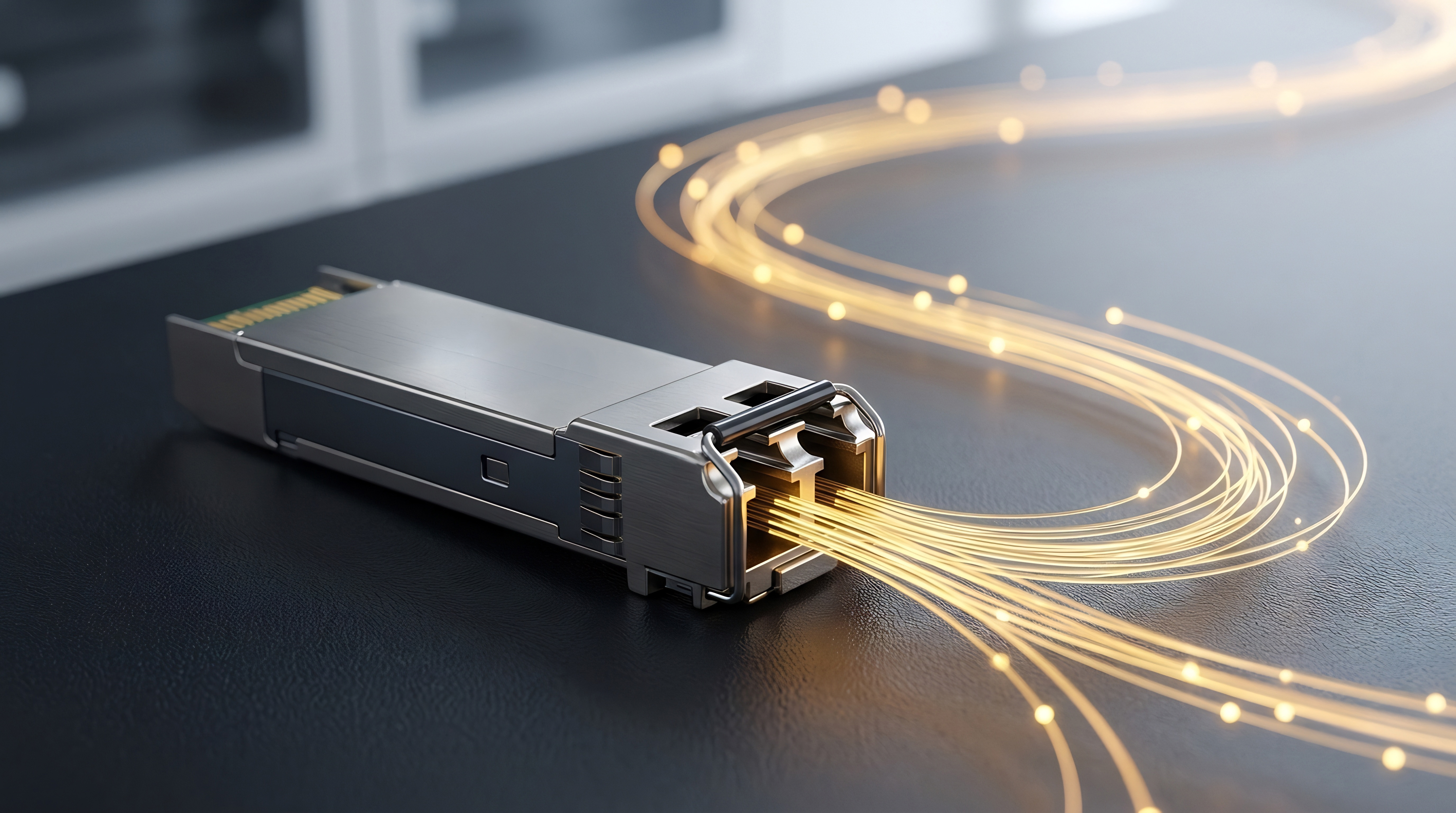


What This Means for Engineers and Sourcing Teams
For design engineers, the X Series offers a drop-in path to tighter jitter budgets without redesigning power delivery around a hungrier component. For sourcing and procurement teams supporting AI infrastructure, networking, and automotive programs, it's also a signal worth tracking: Kyocera's 10x capacity ramp (200,000 to 2 million units/month within six months) suggests the company expects sustained, high-volume demand from hyperscale and enterprise AI server builds — which is good news for lead times and availability as the broader industry scales up AI capacity.
https://www.kyocera-avx.com/news/x-series-differential-clock-oscillators/
FAQ
What is a differential clock crystal oscillator?
A differential clock crystal oscillator generates two complementary output signals instead of one. The receiving circuit reads the voltage difference between them, which cancels out common-mode noise and improves timing stability over longer traces and in electrically noisy environments — making it well suited to high-speed data communication.
What is phase jitter, and why does 30fs matter?
Phase jitter is the small, unwanted variation in the timing of a clock signal's transitions. Lower phase jitter means more precise, consistent timing. At 30 femtoseconds, Kyocera's X Series reduces the risk of bit errors in multi-gigabit serial links, which is critical for AI servers and optical transceivers moving large volumes of data at high speed.
How much power does the Kyocera X Series save compared to older oscillators?
At 156.25 MHz with LV-PECL output, the X Series draws 29 mA versus a typical 50 mA for conventional differential oscillators — a reduction of approximately 42%.
What output frequencies and package sizes are available?
The X Series is available at 100 MHz, 125 MHz, 156.25 MHz, and 312.5 MHz, in LV-PECL or LVDS output, across three package sizes ranging from 2.0 × 1.6 × 0.7 mm up to 3.2 × 2.5 × 1.0 mm.
What are the main applications for differential clock crystal oscillators like the X Series?
Primary applications include AI servers, optical transceivers, high-speed storage systems, and automotive ADAS equipment — anywhere high-speed, long-distance, or noise-sensitive data communication requires precise timing.
Conclusion
Kyocera's X Series differential clock crystal oscillators are a clear response to where AI infrastructure is heading: faster interconnects, tighter jitter budgets, and lower power headroom per board. With 30fs phase jitter, a 42% power reduction, and a rapid capacity ramp to 2 million units per month, the X Series is positioned to become a standard timing component in next-generation AI servers, optical transceivers, and high-speed storage systems.
Looking to source differential clock crystal oscillators or other frequency control components for your next design?